WordPress Website Cost at a Glance
How much does a WordPress website cost in 2026?
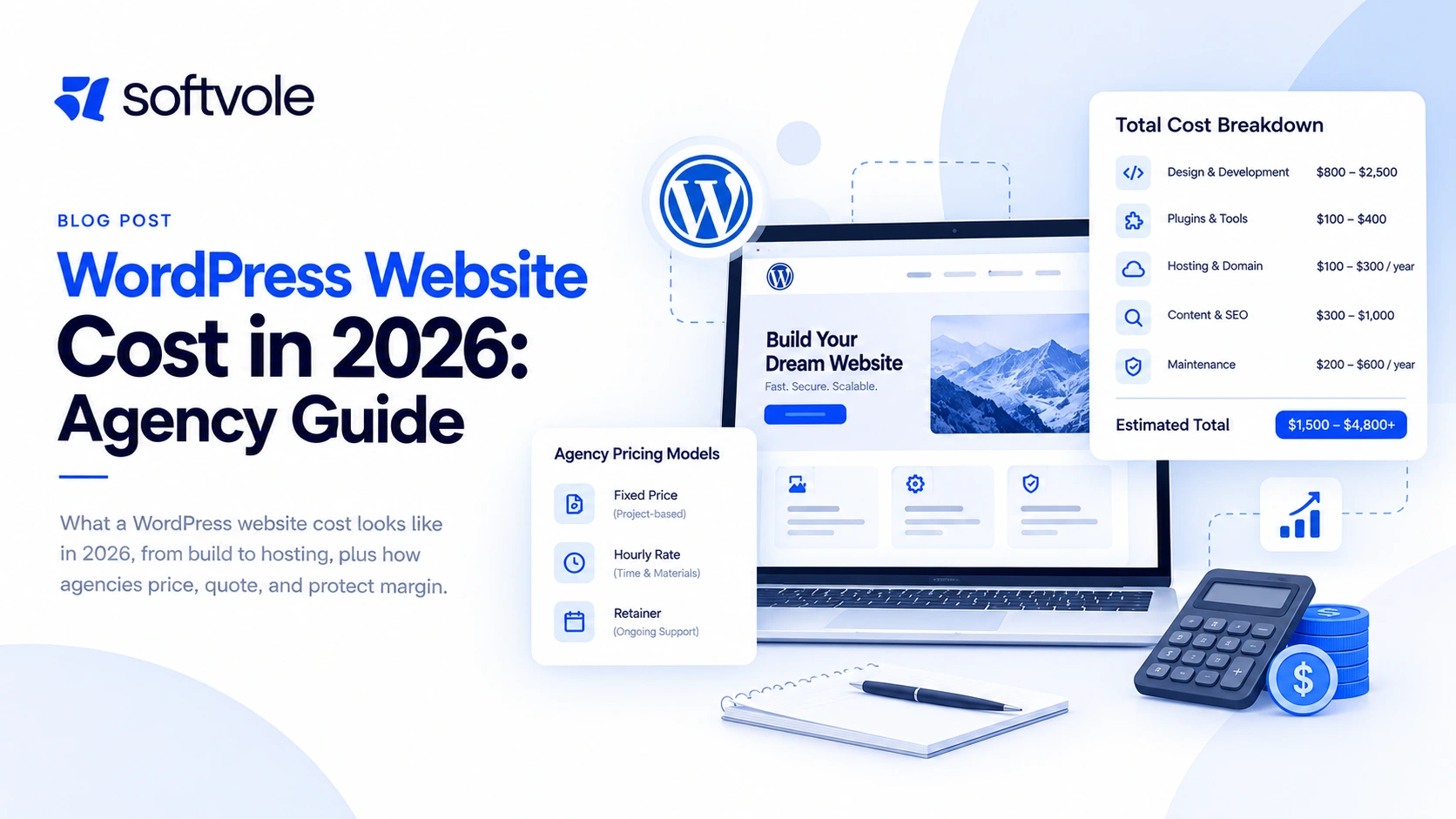
The software is free. Everything around it is not. A WordPress website cost has five parts: strategy and design, development, content, infrastructure (domain, hosting, premium plugins), and ongoing care. The first two dominate the first-year bill. The last one dominates every year after.
Short answer: A professionally built WordPress site in the US typically costs $1,200 to $3,000 for a landing page, $3,500 to $12,000 for a small business site, $12,000 to $40,000 for a custom marketing site with integrations, and $6,500 to $40,000+ for WooCommerce. Add $300 to $1,500 a year for hosting and plugins, and $1,800 or more a year for professional care.
| Site type | Typical scope | Build cost range | Timeline |
|---|---|---|---|
| Landing page | 1 page, form, tracking | $1,200 to $3,000 | 3 to 7 business days |
| Brochure site | 5 to 8 pages, 3 to 4 templates | $2,400 to $6,000 | 2 to 4 weeks |
| Small business site | 10 to 25 pages, blog, design included | $3,500 to $12,000 | 4 to 8 weeks |
| Custom marketing site | 25+ pages, custom blocks, CRM integration | $12,000 to $40,000 | 8 to 14 weeks |
| WooCommerce store | Catalog, checkout, payments, shipping | $6,500 to $40,000+ | 6 to 16 weeks |
These ranges come from published agency price lists and our own fixed-price quotes. Softvole’s white label starting prices sit at the lower end of each band (landing pages from $1,200, multi-page builds from $2,400 with an approved design, design and build from $3,500, WooCommerce from $4,500), because agencies resell them with their own margin on top.
What Actually Drives the Price
Clients tend to ask “how many pages?” The better question is “how many different kinds of pages?” We explain the difference in detail in page count vs template count. A 40-page site built from four templates is cheaper than a 12-page site where every page is unique.
1. Unique templates and custom blocks
Each template needs design, responsive layouts, development, and QA. In our scoping, a unique template usually takes 6 to 14 hours from approved design to tested build. Reusable blocks lower the cost of every page after the first.
2. Design: premium theme, adapted theme, or custom
A premium theme costs $50 to $100 but rarely fits a brand without heavy changes. A custom block theme costs more upfront and less to maintain, because there is no unused code and no page builder lock-in. For brand-led clients, custom almost always wins over three years.
3. Integrations
CRM forms, booking systems, payment gateways, ERP sync, and API feeds add the most variance. A HubSpot form embed is an hour. A two-way inventory sync can be two to four weeks.
4. Content readiness
Projects stall when copy and images arrive late. If the agency is writing content, price it separately. Professional web copy commonly runs $150 to $500 per page in the US.
5. Accessibility, performance, and SEO requirements
WCAG 2.2 AA testing, Core Web Vitals targets, and redirect mapping for a redesign each add hours. They are worth it, but they need to be visible in the quote, not absorbed silently.
Recurring and Hidden Costs Clients Forget
| Item | Typical annual cost | Notes |
|---|---|---|
| Domain | $12 to $30 | Premium TLDs cost more |
| Managed WordPress hosting | $300 to $1,200 | Shared hosting is cheaper but slower and riskier |
| Premium plugins and licenses | $100 to $600 | Forms, SEO, backups, ACF Pro |
| Care plan (updates, backups, monitoring) | $1,200 to $6,000 | $100 to $500 per month depending on scope |
| Small changes and new pages | $500 to $3,000 | Often bundled into a care plan |
Watch the license trap. If plugin licenses are registered to the agency or a freelancer, the client loses updates when the relationship ends. Put licenses in the client’s name, or document them clearly in the handoff.
WordPress itself also has baseline requirements. WordPress.org currently recommends PHP 8.3 or greater and MySQL 8.0 or MariaDB 10.11 or greater. Cheap hosts still running older PHP versions save a few dollars and cost far more in security risk and speed.
How Agencies Should Price a WordPress Build
Agencies that resell white label WordPress production have a simple formula: partner cost plus your own project management, strategy, and margin. Here is a worked example for a 15-page professional services site.
| Line item | Agency cost | Client price |
|---|---|---|
| Discovery and sitemap (agency staff, 8 hrs) | $560 | $1,200 |
| Design and build, 5 templates (white label partner, fixed) | $3,500 | $6,300 |
| Copywriting, 15 pages (freelance writer) | $2,250 | $3,300 |
| Project management and QA review (agency, 10 hrs) | $700 | $1,500 |
| Total | $7,010 | $12,300 |
That quote produces a gross margin of about 43%, which is a healthy target for agency web work. Add a care plan at $199 per site per month on a $149 production cost and the client relationship generates recurring margin long after launch.
Fixed price, hourly, or value-based?
Fixed price is easiest to sell and protects the client. It only protects you if the scope is written tightly and change requests are priced before work begins. Hourly billing suits open-ended support. Value pricing works best when you can tie the site to measurable revenue, such as lead volume for a law firm or orders for a store.
Freelancer, In-House, Agency, or White Label Partner?
| Option | Typical cost | Best for | Main risk |
|---|---|---|---|
| Marketplace freelancer | $15 to $40/hr (Upwork median about $20/hr) | Small, well-defined tasks | Availability and code quality vary |
| In-house developer | BLS median US web developer pay is $99,520/yr before overhead | Steady, high volume | Idle time and single point of failure |
| Full-service agency | $5,000 to $50,000+ per site | Clients who need strategy and build | Higher price |
| White label partner | Fixed project fees, from about $1,200 | Agencies scaling production | Choosing a partner without proof |
How to Reduce Cost Without Cutting Quality
- Approve the design before development starts. Design changes during build are the most expensive kind. Our scoping checklist covers what to lock first.
- Reuse templates. Ask whether a new page really needs a new layout.
- Collect content before kickoff, or price content separately.
- Choose a block theme over a heavy page builder to lower long-term maintenance.
- Phase the project: launch the core site, then add integrations in a second release.
- Use a written WordPress QA checklist so fixes happen before launch, not after.
For a ready-made structure to present these numbers, use our website quote template, or see current developer hourly rates if you are comparing hiring options.
How Timeline Affects Price
Rush projects cost more because they force parallel work and overtime. If a client needs a 15-page site in three weeks instead of seven, expect a premium of 20 to 40%, or a reduced scope. The cheaper alternative is phasing: launch the pages that drive revenue first, then add the rest.
| Phase | Share of budget | What the client gets |
|---|---|---|
| Discovery and architecture | 10 to 15% | Goals, sitemap, wireframes |
| Design | 25 to 35% | Templates, mobile layouts, components |
| Development | 35 to 45% | Theme, blocks, integrations, content entry |
| QA, SEO, and launch | 8 to 12% | Testing, redirects, analytics, training |
| Project management | 8 to 12% | Coordination, approvals, reporting |
How to Explain WordPress Pricing to Clients
Clients compare your quote with a $16 per month website builder or a cousin who “does websites.” Three explanations work well. First, show the line items, so the price stops being one large number. Second, connect the investment to the business outcome, such as leads per month or online orders. Third, show what is not included in cheaper options: redirects, accessibility, speed targets, testing, and support. A clear quote template and published package tiers make this conversation much shorter.
Three Real-World Budget Scenarios
Ranges are useful, but most readers want to know where their own project lands. These three scenarios reflect the projects agencies quote most often.
Scenario A: A local service business replacing a DIY site
A plumbing company with eight service pages, two locations, and a quote form wants to stop relying on a builder site that never ranks. Scope: 12 pages from 4 templates, LocalBusiness schema, call tracking, and a redirect map for 20 old URLs. Realistic budget: $4,500 to $7,500 for design and build, plus about $1,800 a year for hosting and care. The money is well spent on location pages and speed, not on animation.
Scenario B: A B2B firm with a sales team
A manufacturer needs product family pages, spec sheets, a resource library, and HubSpot routing by territory. Scope: 30 pages from 7 templates, a custom post type for products, gated downloads, and CRM integration. Realistic budget: $14,000 to $26,000. Most of the variance comes from product data. If the client already has clean spreadsheets, the import is days. If the data lives in PDFs, it is weeks.
Scenario C: A store moving to WooCommerce
A specialty retailer with 300 products, subscriptions, and wholesale pricing. Realistic budget: $15,000 to $40,000 depending on custom checkout logic and accounting sync. Ongoing care is higher too, often $400 or more per month, because checkout failures cost real revenue.
Red Flags in Very Cheap Quotes
A $900 quote for a 20-page site is not necessarily dishonest, but it usually means something important is missing. Ask whether the price includes a staging environment, responsive testing on real devices, redirects from the old site, accessibility checks, a backup before launch, and documentation. If the answer is no to most of them, the cost has not disappeared. It has moved to the period after launch, when fixing problems is more expensive and more visible.
Before signing off on any budget, check scope readiness with our project scoping checklist so every line item has a reason to exist.
Typical Budgets by Industry
| Industry | What drives cost | Common range |
|---|---|---|
| Law firms | Practice area pages, intake forms, attorney profiles, compliance review | $6,000 to $20,000 |
| Home services | Location pages, call tracking, financing and review widgets | $4,000 to $12,000 |
| Healthcare practices | Provider directories, booking integrations, accessibility | $8,000 to $25,000 |
| B2B manufacturing | Product data, spec sheets, CRM routing | $12,000 to $35,000 |
| Nonprofits | Donation flows, events, volunteer forms | $5,000 to $18,000 |
Industry ranges matter because the expensive part is rarely the page count. It is the industry-specific function each site needs to earn its keep.
6 sites