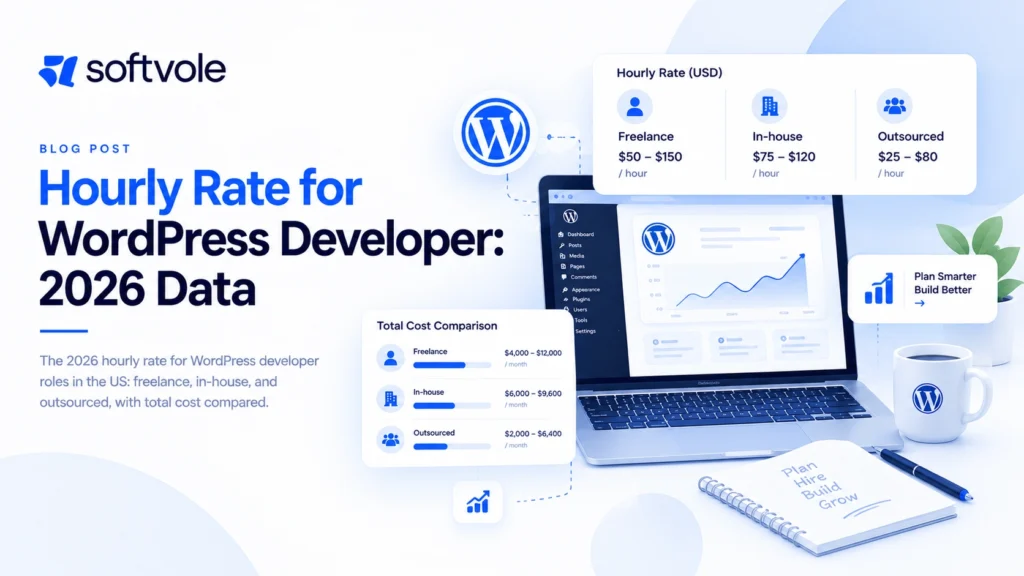
The hourly rate for WordPress developer work in the US ranges from about $15 on freelance marketplaces to more than $150 at senior agencies, and that spread hides the number that matters most to an agency: the cost per productive hour. This guide uses current public data to compare freelance, in-house, and outsourced options on a like-for-like basis.
Hourly Rate for WordPress Developer Roles in 2026
What is the typical hourly rate for WordPress developer work?
There is no single market rate, because the people doing the work are very different. A marketplace freelancer fixing a contact form, an in-house developer, and a senior specialist building a WooCommerce integration are all “WordPress developers.”
Short answer: Marketplace freelancers often charge $15 to $40 per hour (Upwork’s median is about $20). Experienced US freelancers usually charge $60 to $120. US agencies and senior specialists commonly bill $90 to $175. An in-house US web developer earns a median of $47.85 per hour in wages, which becomes roughly $75 to $95 per productive hour once overhead and non-billable time are included.
| Engagement | Typical rate | Source or basis |
|---|---|---|
| Marketplace freelancer | $15 to $28/hr, median about $20 | Upwork cost guide, 2026 |
| Experienced US freelancer | $60 to $120/hr | Published freelancer rate cards |
| In-house employee (wage only) | $47.85/hr median | BLS Occupational Outlook, May 2025 wages |
| In-house employee (true productive cost) | $75 to $95/hr | Calculation below |
| US agency or senior specialist | $90 to $175/hr | Published agency rate cards |
| White label partner, fixed price | Project fee, not hourly | Example: multi-page builds from $2,400 |
The True Cost of an In-House Developer
A salary is not a rate. To compare an employee with an hourly provider, divide total cost by the hours that produce client work.
| Item | Annual amount |
|---|---|
| Base pay (BLS median) | $99,520 |
| Payroll taxes, benefits, equipment, software (about 25%) | $24,880 |
| Total annual cost | $124,400 |
| Paid hours (2,080 minus about 160 hours of holidays and PTO) | 1,920 |
| Productive client hours at 75% utilization | 1,440 |
| Cost per productive hour | About $86 |
Utilization is the swing factor. Agencies with uneven pipelines often see developer utilization fall to 55 or 60% in quiet months, which pushes the effective cost above $100 per productive hour. Recruiting fees and ramp-up time add more.
What Moves a Developer’s Rate Up or Down
Specialization
WooCommerce, custom plugins, API integrations, performance engineering, and accessibility remediation command higher rates than theme setup or content updates.
Location
US rates are highest in major metros on the coasts. Offshore teams cost less per hour, but the comparison only holds if quality, communication, and rework are similar.
Seniority and accountability
Senior developers cost more per hour and often less per project, because they make fewer mistakes, need less review, and estimate more accurately.
Engagement model
Short ad hoc tasks cost more per hour than steady, scheduled work. Dedicated monthly arrangements usually lower the effective rate.
Hourly vs Fixed Price: Which Costs Less?
Hourly billing transfers risk to the buyer. If the developer underestimates, you pay for it. Fixed pricing transfers estimation risk to the provider, which is why it works best for defined scopes with approved designs.
- Choose hourly for open-ended support, debugging unknown issues, and small changes.
- Choose fixed price for builds, redesigns, migrations, and integrations with clear requirements.
- Choose a dedicated developer when you have steady work of 80 or more hours a month across clients.
How Agencies Should Compare Options
- Estimate your monthly WordPress hours honestly, including quiet months.
- Calculate the in-house cost per productive hour at realistic utilization.
- Get fixed quotes for two typical projects from potential partners. A clear project scope makes quotes comparable.
- Compare total project cost, not hourly rate, including review and rework time.
- Factor in risk: availability, backup coverage, documentation, and client confidentiality. If white label is new to you, start with what white label services are and why agencies choose Softvole.
Rule of thumb: if your developer workload is below about 0.8 of a full-time role or swings by more than 30% month to month, a partner or dedicated outsourced developer usually costs less than a hire.
Rates by Skill Set
| Specialty | Relative rate | Why |
|---|---|---|
| Content updates and page assembly | Lower | Repeatable, low risk |
| Theme development from approved designs | Medium | Front-end and block expertise |
| WooCommerce and payments | Higher | Revenue risk, complex testing |
| Custom plugins and API integrations | Higher | Architecture, security, reliability |
| Performance and Core Web Vitals | Higher | Diagnosis across stack |
| Accessibility remediation | Higher | Specialized testing skills |
Red Flags When Hiring at Any Rate
- No questions about scope before quoting.
- No staging environment or version control.
- Plans to solve everything with more plugins.
- No documentation or handoff process.
- Unclear ownership of code and licenses.
- Willingness to contact your client directly.
A good test project reveals more than any rate card. Give two candidates the same small, well-scoped task and compare code quality, communication, and the time your team spent reviewing it.
How to Estimate Hours Before Comparing Rates
A rate is only useful when multiplied by a realistic number of hours. These planning ranges help agencies sanity-check estimates from any provider.
| Task | Typical hours |
|---|---|
| Landing page from approved design | 12 to 24 |
| One unique page template (design to tested build) | 6 to 14 |
| Contact form with CRM delivery | 2 to 6 |
| Custom post type with filters | 10 to 30 |
| Redirect map and launch checks for 50 URLs | 4 to 8 |
| Speed audit and fixes for one template | 6 to 16 |
| Simple third-party API sync | 20 to 60 |
If a quote is far below these ranges, ask what is excluded. If it is far above, ask what assumptions drive it. Either conversation reveals more about the provider than the rate itself.
The Hidden Costs Behind Every Rate
Review time
Someone on your team reviews the work. A junior developer at $25 per hour who needs two hours of senior review for every five hours of work costs more than the rate suggests.
Rework
Bugs found after launch take longer to fix because the context is gone. Providers who test before handoff save you money even at higher rates. Our WordPress QA checklist shows what thorough testing covers.
Communication overhead
Time zones, unclear specifications, and slow replies add days. Ask any provider how they report progress and how quickly they respond during your working hours.
Turnover risk
If one freelancer holds all the knowledge about a client site, their departure becomes your emergency. Documentation and backup coverage reduce that risk.
When a Dedicated Developer Makes Sense
A dedicated developer works only on your accounts for a set number of hours each month. It suits agencies with a steady flow of small and medium tasks across many client sites: template tweaks, landing pages, plugin issues, and content tooling. The effective rate is usually lower than ad hoc hourly work because the developer builds context on each site and you avoid re-onboarding costs. The trade-off is commitment: you pay for capacity whether you use all of it or not.
How to Discuss Rates Without Damaging Quality
- Offer predictable volume in exchange for a better rate, rather than pushing the rate down per task.
- Bundle similar work, such as five landing pages at once, to reduce context switching.
- Provide complete briefs and approved designs; clarity is the cheapest discount you can give yourself.
- Agree on fixed prices for repeatable work and keep hourly billing for unknowns.
Whatever model you choose, compare total delivered cost per project over a quarter, not the headline rate. That is the number that shows up in your margins.
How Location Affects US Rates
Within the US, rates track local living costs and demand. Developers in major coastal metros such as San Francisco, New York, Seattle, and Boston typically charge the highest rates. Rates in much of the Midwest and South are usually lower for similar experience. Remote work has narrowed the gap, because developers can sell to clients anywhere, but local agencies still price with regional expectations in mind. When comparing quotes, compare like with like: a senior developer in a lower-cost region may offer the best value of all.
Onshore, Nearshore, and Offshore Teams
| Model | Typical advantage | What to verify |
|---|---|---|
| Onshore (US) | Same time zone, cultural familiarity | Higher rates; check availability |
| Nearshore (Latin America) | Overlapping hours, moderate rates | Seniority and English communication |
| Offshore (South Asia, Eastern Europe) | Lower rates, ability to work overnight | Process maturity, QA standards, overlap hours |
The location matters less than the operating model. A well-run offshore team with senior developers, written QA, and a project lead who overlaps with US hours can outperform a local freelancer who juggles too many clients. Judge partners by process, communication, and the quality of a pilot project.
Setting Your Own Agency Billing Rate
If your agency bills clients hourly for development, the rate must cover production cost, project management, sales time, overhead, and profit. A simple method: take your full production cost per productive hour (for example, $86 from the in-house calculation above, or your partner’s effective rate), add 15 to 25% for project management and account time, then apply a target margin of 30 to 50%. That puts many US agencies between roughly $120 and $175 per hour, consistent with the market rates shown earlier.
Questions That Reveal a Developer’s Real Level
- How would you structure a site so editors can build new pages without breaking the design?
- Walk me through how you would diagnose a page with slow Largest Contentful Paint.
- How do you handle plugin updates on a live client site?
- When would you build a custom plugin instead of using an existing one?
- How do you hand off a project so another developer can maintain it?
Senior developers answer with process, trade-offs, and examples. Junior developers answer with tools. Both have value, but the rate you pay should match the level you actually need for the work in front of you.
Where Rates Are Heading
Three forces are shaping WordPress developer pricing. First, AI-assisted coding tools speed up routine tasks such as boilerplate code, simple blocks, and documentation, which puts pressure on rates for basic work. Second, demand keeps rising for skills those tools do not replace: architecture decisions, performance diagnosis, accessibility remediation, secure integrations, and the judgment to know what not to build. Third, the BLS projects employment for web developers and digital designers to grow 5% from 2025 to 2035, faster than average, so experienced talent is likely to stay in demand. The practical takeaway is that the gap between commodity tasks and senior expertise is widening. Pay less for routine work by productizing it, and pay well for the decisions that protect client revenue.
-91%