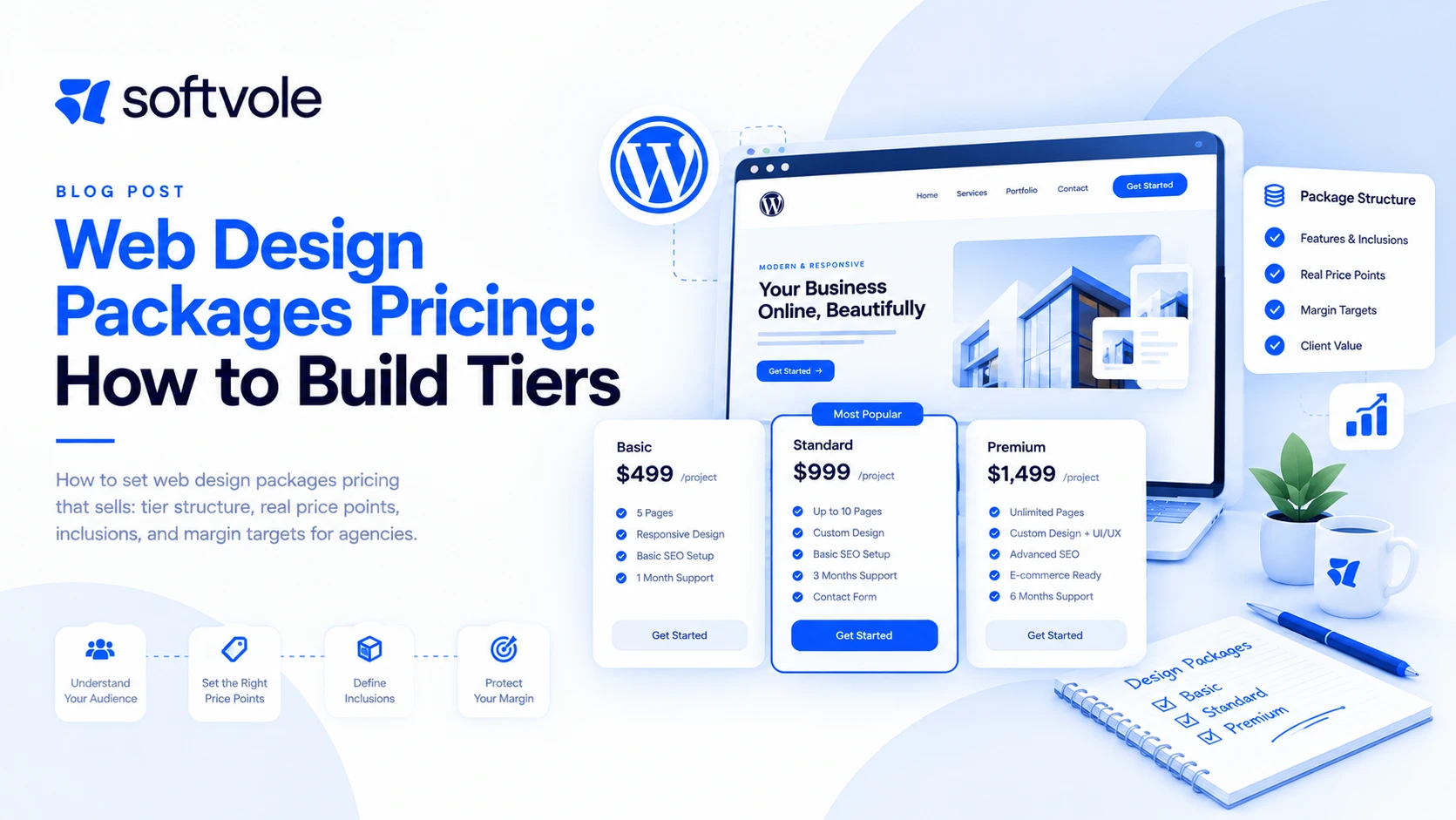
Getting web design packages pricing right is less about picking numbers and more about deciding what each tier promises. Packages make websites easier to buy, faster to quote, and more profitable to deliver, but only when the tiers match how clients think about their business. Here is a practical framework with real US price points.
Why Web Design Packages Pricing Beats Custom Quotes for Most Projects
When web design packages pricing works best
Packages work when your projects follow a pattern: similar page counts, similar features, and similar clients. They work poorly for complex custom builds where every requirement changes the effort. Most agencies end up with both: packages for the 70% of projects that fit, and custom quotes for the rest.
Short answer: Build three tiers around outcomes (launch, grow, scale), set clear limits on templates, pages, and revisions, and price them so your delivery cost leaves a 40 to 50% gross margin. In the US, common agency ranges are about $2,500 to $5,000 for a starter site, $6,000 to $12,000 for a growth site, and $12,000 to $25,000 for an advanced site.
A Three-Tier Package Framework
| Launch | Growth (most popular) | Scale | |
|---|---|---|---|
| Who it’s for | New or small businesses | Established businesses focused on leads | Multi-service or multi-location businesses |
| Pages | Up to 6 | Up to 20 | Up to 50 |
| Unique templates | 3 | 6 | 10+ |
| Design | Brand-adapted | Custom | Custom with design system |
| Integrations | Contact form | CRM, call tracking | CRM, booking, location data, custom blocks |
| SEO | Basics | Redirect map, schema, analytics | Full migration plan, local SEO pages |
| Revisions | 2 rounds | 2 rounds per stage | 3 rounds per stage |
| Timeline | 2 to 3 weeks | 5 to 7 weeks | 8 to 12 weeks |
| Typical price | $2,500 to $5,000 | $6,000 to $12,000 | $12,000 to $25,000 |
The middle tier should be the obvious choice for your ideal client. Price the top tier high enough to make the middle look reasonable, and make sure it delivers real extra value, not just more pages.
Setting Price Points With Margin in Mind
Start from delivery cost
Calculate what each tier costs you to deliver (our quote template lists every line), including design, development, QA, project management, and account time. If you use a white label partner, the production part is a fixed number. Softvole’s starting prices, for example, are $1,200 for a landing page, $2,400 for a multi-page build with approved design, and $3,500 for design and development together.
Apply a margin target
| Cost item | Amount |
|---|---|
| Production (white label, fixed) | $4,200 |
| Strategy and discovery (agency) | $700 |
| Project management and QA review (agency) | $800 |
| Total delivery cost | $5,700 |
| Package price | $9,800 |
| Gross margin | 42% |
Check against the market
Compare your tiers with three to five competitors in your niche and region. If you are much cheaper, you are probably underselling strategy. If you are much more expensive, your package page must show why, with case studies and outcomes.
Add-Ons That Raise Average Deal Size
- Copywriting per page
- Additional templates or landing pages
- Accessibility audit and remediation against WCAG 2.2
- Speed optimization with Core Web Vitals targets
- Monthly care plan (recurring), delivered through white label care
- Content or SEO retainer (recurring)
Make care the default. Include the first three months of a care plan in the Growth and Scale tiers. Clients who experience care rarely cancel it, and it turns a one-time project into recurring revenue.
Should You Publish Package Prices?
Publishing “starting at” prices (like our own pricing page) filters out leads with mismatched budgets and builds trust. It also makes your pages more useful to search engines and AI assistants, which increasingly answer pricing questions directly. Keep exact quotes for complex projects, but show enough to set expectations.
Package Pitfalls to Avoid
- Vague limits such as “a few pages” or “minor changes.”
- Tiers that differ only in page count.
- No exclusions list, which invites scope creep.
- Prices that do not cover project management.
- Delivering every package as a custom build, which erases the margin. See how a home services redesign stayed on a fixed scope.
How to Present Packages on Your Website
- Show three cards side by side with “most popular” on the middle tier.
- Use “starting at” prices and list what is included and excluded.
- Add a short “Which package fits?” guide based on business type.
- Place proof (case studies, results) directly below the cards.
- End with one clear action, such as booking a scoping call.
Example: Package Mix and Annual Revenue
| Package | Projects per year | Price | Revenue |
|---|---|---|---|
| Launch | 10 | $3,900 | $39,000 |
| Growth | 14 | $9,800 | $137,200 |
| Scale | 4 | $18,500 | $74,000 |
| Care plans (20 sites, $249/mo) | Recurring | $2,988/site/yr | $59,760 |
| Total | $309,960 |
The recurring line is what smooths cash flow. For how to structure it, see our WordPress maintenance plans guide.
Position Packages Around Who They Serve
Generic tiers compete on price. Niche tiers compete on fit. A “Growth” package means little; a “Growth package for multi-location dental practices” tells a buyer you understand their problems before the first call. If your agency serves two or three industries, consider industry-specific package pages that share the same delivery system underneath. The build is the same; the inclusions, examples, and language change.
Price Anchoring and the Decoy Effect
Buyers judge prices relative to the options in front of them. A high top tier makes the middle tier feel reasonable, and a sparse bottom tier makes the middle feel complete. Use this honestly: every tier must be a good deal for the right client. The goal is to help buyers self-select, not to trick them. If almost nobody ever buys your top tier, check whether it is priced too high or simply designed for clients you do not attract.
How to Deliver Packages Profitably
Packages only make money when delivery is repeatable. That means a component library built once and reused, a standard plugin stack, consistent QA, and a fixed handoff process. Each new package project should start from the same foundation, with design effort going into brand expression rather than rebuilding common elements like headers, forms, and testimonial blocks.
| System | What it standardizes | Effect |
|---|---|---|
| Component library | Common sections and blocks | Fewer design and build hours |
| Standard plugin stack | Forms, SEO, caching, security | Easier maintenance across clients |
| Onboarding questionnaire | Content and asset collection | Fewer delays |
| QA checklist | Testing before handoff | Fewer post-launch fixes |
| Fixed partner pricing | Production cost per tier | Predictable margin |
Handling Requests That Fall Between Tiers
Clients often want the lower tier plus one feature from the higher tier. Price add-ons individually so you can say yes without discounting the tier. If a client needs three or more add-ons, the next tier is usually better value for them, and showing that math builds trust.
Discounts: When and How
- Avoid discounting the package price itself; it resets expectations for future work.
- Offer added value instead, such as an extra month of care or one additional landing page.
- Use time-based incentives sparingly and tie them to your schedule, for example a slot opening next month.
- For nonprofits, publish a clear policy rather than negotiating case by case.
When to Raise Package Prices
Review prices at least once a year. Signs you are underpriced include a close rate above roughly 50%, a backlog stretching more than six weeks, and clients who never question the price. Raise prices for new clients first, keep existing clients on current pricing for a defined period, and update your published “starting at” figures. Pair the change with improvements the client can see, such as faster delivery or an added care period, and refer to your pricing page structure as a model for clear presentation.
Package Examples by Business Type
| Business type | Starter focus | Growth focus | Scale focus |
|---|---|---|---|
| Local services | Core pages, call tracking | Location and service pages, reviews | Multi-location structure, booking |
| Professional services | Credibility and contact | Practice pages, case studies, CRM | Resource library, gated content |
| B2B companies | Product overview, lead form | Product families, spec sheets | Integrations, portals, multilingual |
| Ecommerce | Small catalog, standard checkout | Larger catalog, email automations | Subscriptions, wholesale, ERP sync |
Pricing Ecommerce Packages
Store packages need different limits than brochure sites. Define them by product count, product types (simple, variable, subscription), payment gateways, shipping complexity, and integrations. A starter store with up to 50 simple products and standard shipping can be packaged cleanly; anything with custom checkout logic, wholesale pricing, or accounting sync usually belongs in a custom quote. Production costs for WooCommerce typically start higher than brochure sites, so the margin math must be done separately.
Packages as Monthly Subscriptions
Some agencies sell websites as a subscription instead of a one-time fee: no large upfront payment, a monthly price that covers the site, hosting, care, and small updates, and a minimum term of 12 to 24 months. It suits small businesses that prefer predictable costs and agencies that want recurring revenue. The model only works when build time is low, so it depends on productized templates and standardized care. Define ownership clearly in the terms, including whether the client can buy out the site if they leave.
Answering Common Package Objections
“Another agency quoted less.” Compare scope line by line, especially design approach, templates, SEO protection, and care. “We only need a few pages.” Offer the starter tier with a clear upgrade path. “Can you do it faster?” Explain what would be phased to meet the date rather than promising rushed work. “Do we need the care plan?” Show what it prevents: outages, security issues, and slow decay of speed. Prepared answers make package sales consistent across your team, not dependent on one salesperson.
Metrics to Track for Your Packages
Track close rate by tier, average deal size, delivery hours per tier, gross margin per project, add-on attach rate, and care plan conversion. Review them every quarter. These numbers tell you which tier needs repricing, which add-ons are worth promoting, and where delivery is drifting over budget.
Delivering Packages With a White Label Partner
Agencies that use a production partner can map each tier to a fixed partner price, then focus their own team on strategy, content, and client management. Share the tier definitions with the partner so scope matches exactly, agree on standard components for each tier, and review the first few deliveries closely. When production cost per tier is fixed, margin becomes predictable and sales can quote confidently without checking capacity every time. Softvole supports this model through white label WordPress development with fixed pricing per scope.
34 to 9 hrs