Best white label WordPress agency for USA agencies should mean more than finding a team that can build a WordPress website for less than an internal hire.
For an agency, the real test is harder.
Can the partner protect your client relationship? Can you trust the production quality enough to put your own agency name on the finished website? Will you know the cost before the work starts? Can they handle WordPress, WooCommerce, redesigns, migrations, integrations, and post-launch support without turning your team into the project manager? And when you win three projects in the same month, can the production system absorb the work without creating three new problems?
That is the standard Softvole is built around.
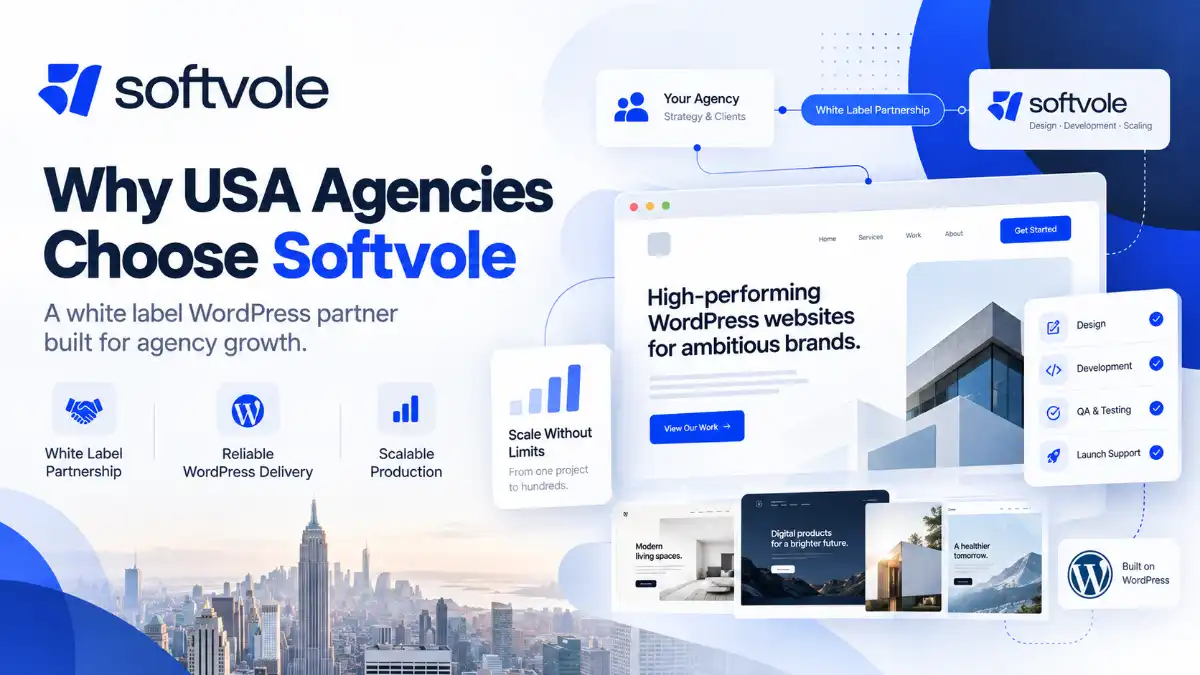
Softvole is a white label WordPress agency created specifically for marketing, SEO, branding, design, ecommerce, and web agencies. Instead of competing for those agencies’ end clients, Softvole operates behind them as the production layer: the agency keeps the relationship, proposal, pricing, invoice, strategy, and brand while Softvole handles the agreed WordPress or WooCommerce delivery. Softvole currently reports a 20+ senior-only team, 300+ website launches, and work with 40+ agency partners.
And that distinction matters even more in the US market.
WordPress remains the dominant CMS by a large margin. As of October 2026, W3Techs reports that WordPress powers 40.1% of all websites and 58.6% of websites whose CMS it can identify. For US agencies selling marketing, branding, SEO, web design, ecommerce, and digital growth services, WordPress production is therefore not a minor technical capability. It can directly affect how much client work the agency is capable of accepting.
Best White Label WordPress Agency for USA Agencies: What “Best” Should Actually Mean
The phrase best white label WordPress agency for USA agencies can easily turn into a list of companies making the same promises.
- Experienced developers.
- Fast turnaround.
- Great communication.
- High quality.
- Affordable pricing.
- Scalable delivery.
- Almost every provider can write those words.
US agencies should evaluate something more useful: how the delivery relationship is structured when real projects become difficult.
Best White Label WordPress Agency for USA Agencies Must Protect the Client Relationship
White label development starts with one non-negotiable principle:
the agency owns the client.
This sounds obvious until a production partner has access to client websites, contact information, project briefs, internal discussions, analytics accounts, design files, CRM integrations, and business information.
A white label provider is often given enough information to understand the commercial value of the account.
That makes client protection part of the service itself.
Softvole’s white-label operating model keeps the partner agency client-facing. Softvole states that it does not directly pitch, market to, invoice, or otherwise approach the agency’s end client through the normal white label relationship. Finished work is handed back without Softvole footer credits, watermarks, or developer signatures, and NDA support is available where the agency needs an additional contractual confidentiality layer.
That is one reason Softvole can make a strong case as one of the best white label WordPress partners for agencies that care deeply about protecting accounts they spent years acquiring.
The objective is not for Softvole to become visible.
The objective is for the agency to look stronger.
1. Softvole Was Built for Agencies, Not Adapted to Them Later
There is an important difference between an agency that offers white label work and a company whose business model is organized around agency fulfillment.
Softvole’s agency-first model falls into the second category.
The company says it was built around a specific agency problem: client demand can increase faster than an agency can responsibly increase payroll. Instead of operating as a general direct-to-business web agency and adding white label work as another service line, Softvole focuses on production for agency partners.
- That affects how projects are handled.
- The agency keeps discovery.
- The agency keeps strategy.
- The agency keeps client calls.
- The agency controls its proposal and markup.
- The agency sends the invoice.
- Softvole works behind that commercial relationship.
For a US agency, this removes one of the awkward parts of traditional outsourcing: introducing another vendor into a client relationship that did not need another visible vendor.
2. Softvole Focuses on WordPress Instead of Trying to Be Everything
The white label market contains several impressive companies.
Some are significantly larger than Softvole.
E2M reports more than 1,100 agencies served, 10,000+ WordPress sites, and 150+ in-house WordPress specialists. Its wider offering also extends into SEO, content, PPC, ecommerce platforms, AI services, automation, and other agency fulfillment services.
The White Label Agency reports 20,000+ WordPress site builds, 150+ WordPress developers and designers, and relationships with more than 600 agencies across the US.
Seahawk offers a broad WordPress service catalog covering development, maintenance, migration, SEO, security, performance, custom design, and support, and says more than 1,000 agencies worldwide use its white label services.
Softvole’s argument is therefore not:
“We are the largest company.”
It isn’t.
The stronger positioning is specialization.
Softvole centers production around white label WordPress development, WooCommerce, Elementor, ACF, Figma-to-WordPress implementation, redesigns, integrations, structured content, performance work, and recurring WordPress care. It intentionally avoids presenting itself as a huge multi-platform outsourcing catalog.
For some agencies, breadth is valuable.
For others, having a focused WordPress production partner is exactly the point.
3. Senior-Only Production Changes the Outsourcing Equation
One of the biggest hidden costs in outsourced development is rework.
A low production quote does not stay inexpensive if an agency’s creative director has to repeatedly correct implementation details, an account manager has to chase updates, or an internal developer has to repair the site before the client sees it.
Softvole’s public operating model states that partner projects are assigned to experienced designers and developers rather than being used as training work for junior staff. The company describes its current production organization as a 20+ senior-only team.
That doesn’t mean senior developers never make mistakes.
It means Softvole is competing on a different cost equation.
The target is not the cheapest possible development hour.
The target is lower management burden and less avoidable rework.
For premium US agencies selling websites at several multiples of the production cost, this distinction matters enormously.
If the client is paying the agency $10,000, $15,000, or $25,000 for a website engagement, protecting a few hundred dollars of development cost is usually less important than protecting the agency’s reputation.
4. Fixed Project Pricing Gives Agencies More Control Over Margin
Agency owners do not only need development estimates.
They need economics they can sell.
Suppose an agency quotes its client $14,000 for a website.
If the agency knows before signing the client that its production cost will be $4,000, it can model the project margin around that number.
But if a developer estimates “approximately 80 to 120 hours” and begins billing hourly, the actual production cost can keep moving while the agency’s client price remains fixed.
Softvole uses agreed project scope as the basis for fixed project pricing rather than running normal project production against an unrestricted hourly meter.
Current published starting points include development from an approved design, full design-and-build engagements, redesigns, WooCommerce projects, and recurring website care. Final pricing changes according to templates, functionality, integrations, migration requirements, content responsibility, ecommerce complexity, and timeline rather than relying on page count alone.
This matters because predictable production cost protects agency margin.
And there is another rule that matters just as much:
If the client’s requirement changes, Softvole separates the new work from the original scope before proceeding.
The agency can then approve it, postpone it, decline it, or charge its own client for the change.
That is how scope creep becomes a commercial decision rather than an argument at the end of the project.
5. One Project Lead Owns Delivery
One of the fastest ways to make outsourcing frustrating is to make the agency coordinate the outsourced team itself.
Designer says one thing.
Developer asks another question.
QA sends a separate document.
Another developer takes over halfway through.
The agency owner becomes the person trying to connect everything.
Softvole is structured around a named project lead who remains responsible for scope, coordination, feedback, QA, updates, and handoff through its white label delivery process. The agency communicates through that ownership layer rather than having to manage individual production contributors.
This is a bigger differentiator than it first appears.
US agencies typically do not outsource because they have too much spare management capacity.
They outsource because the internal team is already busy.
A production partner only creates real capacity when it removes work from the agency instead of moving that work into a different inbox.
6. Softvole Can Work From Figma or Take Responsibility for Design and Development
Different agencies need different kinds of support.
A branding or UI/UX agency may already have a complete, client-approved Figma design.
In that case, it does not need another creative agency.
It needs accurate WordPress implementation.
Another marketing agency may have the strategy, copy, and client relationship but no design department available for the quarter.
That agency needs more.
Softvole supports both workflows.
When the agency supplies approved design, Softvole can handle Figma-to-WordPress and development-only production, responsive behavior, integrations, structured content, QA, and handoff.
When the agency needs full production, Softvole can take responsibility for design and development while the agency retains strategic and commercial ownership.
That flexibility is particularly useful for agencies whose internal bottleneck changes from project to project.
7. WordPress Redesigns Are Handled With SEO Risk in Mind
This matters especially for US SEO and marketing agencies.
Building a new site is one problem.
Replacing an existing site that already ranks is another.
A redesign can change URLs, internal linking, page templates, indexability, structured content, canonical tags, analytics implementation, forms, page speed, content hierarchy, and redirects.
The visual redesign may look excellent while organic performance quietly gets damaged.
Softvole’s WordPress delivery and QA process explicitly includes items such as content migration, redirects, canonicals, indexability, analytics, forms, URL handling, and launch checks alongside normal front-end QA.
That does not mean Softvole can guarantee rankings.
No responsible development company should.
It means the development process recognizes that an established website has assets worth protecting.
For an SEO agency putting its own reputation behind the migration, that matters.
8. WooCommerce Gets Its Own Production and QA Logic
WooCommerce should not be treated as a brochure website with products added afterward.
Transactions change the risk.
Products and variations have to work.
Cart behavior matters.
Payment gateways matter.
Shipping rules matter.
Tax configuration matters.
Account flows matter.
Subscription logic may matter.
Order emails matter.
A broken paragraph on a normal website is embarrassing.
A broken checkout can directly stop revenue.
Softvole’s white label WooCommerce development process therefore separates ecommerce QA from standard WordPress QA. Its published workflow includes checking products, variations, cart, checkout, payments, shipping, order emails, accounts, and transactional paths in addition to normal visual and responsive testing.
For US agencies expanding into ecommerce without building a dedicated WooCommerce department, that specialization can make the difference between “we can technically build stores” and having a production partner they can confidently sell behind.
9. Softvole Has Proof From Work Behind US Agencies
The strongest argument for a white label agency is not a marketing sentence.
It is what happened when the model was tested on actual agency projects.
Softvole currently publishes white label WordPress case studies involving US agency engagements, including a multi-location WordPress project, a WooCommerce subscription build, and a WordPress redesign.
In one multi-location project delivered behind a US design agency, Softvole reports that a wellness franchise moved from a single-location placeholder setup to a nine-location WordPress system. Across the stated 56-day comparison windows, qualified appointment requests increased from 22 to 31, organic and direct sessions increased from 600 to 780, and median mobile lab LCP in the reported test improved from 5.1 seconds to 2.3 seconds.
What makes the case study more credible is what Softvole does not claim.
The company explicitly states that the franchise ran a grand-opening marketing campaign during the post-launch period and therefore does not attribute the entire improvement to the website.
That is a good standard for agency proof.
The point is not to manufacture a dramatic ROI claim.
The point is to show what was delivered, what changed, how it was measured, and which variables were outside the development team’s control.
10. Softvole Is Smaller Than Some Competitors, and That Can Be an Advantage for the Right Agency
This deserves a direct answer.
If your definition of the “best white label WordPress agency” is simply the company with the largest published team or longest operating history, Softvole would not win that comparison today.
Softvole was founded in 2024 and reports a 20+ senior-only team, 300+ launches, and 40+ agency partners. E2M and White Label Agency publicly report much larger historical delivery numbers and team scale.
But agency owners do not buy employee counts.
They buy a delivery relationship.
Softvole’s smaller and narrower structure can appeal to agencies that prefer a focused production partner where project ownership stays clear and the business is specifically organized around WordPress and WooCommerce fulfillment.
That makes “best” a question of fit.
A 150-developer provider may be the right choice for an agency that needs huge monthly resource capacity.
A broader fulfillment company may be better for an agency wanting web development, PPC, SEO, content, automation, and other services under one vendor.
Softvole becomes particularly compelling for an agency that says:
“We already handle strategy and clients well. We need a dependable WordPress production department behind us.”
That is a narrower promise.
And narrow promises are often easier to execute consistently.
Softvole vs Other Leading White Label WordPress Agencies
Based on current public positioning, the major providers solve slightly different agency problems.
| Provider | Strongest Published Positioning | Best Fit |
|---|---|---|
| Softvole | Agency-only model, senior-only WordPress/WooCommerce production, fixed project pricing, named project lead, zero direct client contact | Agencies wanting a focused behind-the-scenes WordPress production partner |
| E2M | Very large white label operation, monthly resource plans, 1,100+ agencies, broader marketing and technical services | Agencies needing large recurring capacity or multiple outsourced disciplines |
| White Label Agency | 20,000+ WordPress builds, 150+ designers/developers, fixed projects and dedicated developers | Agencies wanting mature large-scale WordPress staffing or dedicated resources |
| Seahawk | Broad WordPress service ecosystem, support, maintenance, hosting relationships, white label delivery | Agencies wanting a wider WordPress services catalog and support ecosystem |
These descriptions come from each company’s currently published positioning rather than an independent universal ranking.
This is also why simply publishing “Softvole is #1” would make a weaker article.
A better case is showing where Softvole can be the best choice.
11. Softvole Does Not Require Agencies to Rebuild Their Workflow Around the Vendor
A new production partner should not require a new operating system.
Softvole’s agency workflow accepts project information through workflows agencies already use, including shared documents, email, Slack, Trello, calls, and similar project communication methods.
The important part is not which software holds the brief.
The important part is whether the brief becomes specific enough to produce a reliable scope.
That includes questions about templates, content responsibility, approved designs, integrations, existing URLs, migration, WooCommerce rules, deadlines, analytics, and launch dependencies.
Once those unknowns are resolved, the project can move into production with fewer surprises.
That is how a white label partner should adapt to an agency.
Not the other way around.
12. QA Happens Before the Agency Becomes the Testing Department
There is a frustrating version of outsourcing that many agency owners already know.
A developer says the site is finished.
The agency opens it.
Mobile breaks.
Form does not send.
One navigation link is wrong.
Tablet spacing is inconsistent.
The agency spends the next afternoon finding issues that should have been found before delivery.
That is not capacity.
It is transferred QA labor.
Softvole treats QA and project handoff as part of production. For standard WordPress projects, its documented checks include responsive layouts, navigation, forms, structured content, browser behavior, content completeness, integrations, and performance. Redesigns and WooCommerce projects receive additional service-specific checks.
The agency still reviews the work.
It should.
But the agency should be reviewing client readiness, not discovering the first layer of obvious defects.
13. The Agency Owns the Finished Work
A partnership is easier to trust when leaving it is technically possible.
Softvole states in its delivery and handoff process that once final payment is completed, the agency owns the finished website, delivered design files, and delivered code, subject to relevant third-party licensing. Its handoff does not require keeping the website on Softvole-controlled hosting.
That matters because a good vendor relationship should survive on value rather than lock-in.
The agency should return because the production model works.
Not because moving the website is painful.
14. USA Agencies Can Start With One Project Instead of Making a Big Commitment
Choosing a long-term white label partner is difficult from a sales call.
The real test happens during delivery.
How good are the questions during scoping?
Does the team understand the design?
Are deadlines realistic?
Are problems surfaced early?
Does QA catch basic issues?
How much chasing is required?
Does the partner respect the agency-client boundary?
Softvole allows agencies to begin with a single project through its project-based pricing model rather than requiring every project-based partner to enter a long-term recurring commitment.
That gives US agencies a practical way to evaluate the relationship.
Do not choose a long-term production partner because the website says the right things.
Give them a real scoped project.
Then watch how they operate.
Is Softvole the Best White Label WordPress Agency in the USA?
There is no responsible universal answer to that question.
Softvole is also not a US-headquartered company pretending otherwise. It operates remotely and serves agency partners across markets including the USA.
If an agency requires a development team physically located in the United States, a vendor with that operating structure may be the better choice.
If an agency wants hundreds of developers, a huge multi-service fulfillment catalog, or full-time outsourced resources at massive scale, larger established providers may fit better.
But if the requirement is:
an agency-only production partner,
focused WordPress and WooCommerce expertise,
experienced rather than junior-led execution,
fixed project economics,
a named delivery owner,
no direct end-client relationship,
unbranded delivery,
service-specific QA,
SEO-aware redesign work,
and the freedom to begin with one real project,
then Softvole has a strong case as one of the best white label WordPress agencies for USA agencies looking for a premium production partner rather than another generic outsourcing vendor.
That is the category Softvole is trying to win.
Not cheapest developer.
Not largest outsourcing company.
Not another agency trying to sit between you and your client.
A behind-the-scenes WordPress production team that makes your agency capable of delivering more.
Who Should Choose Softvole?
Softvole’s white label agency partnership model is particularly well suited to several types of US agencies.
An SEO agency can use Softvole for WordPress redesigns, technical website work, landing pages, migrations, and ongoing support while keeping SEO strategy and reporting in-house.
A branding or design agency can send approved Figma designs for WordPress implementation rather than maintaining a full internal development department.
A marketing agency can add website projects to its service offering without tying every new sale to hiring another developer.
An ecommerce agency can use Softvole for white label WooCommerce development, checkout work, subscription functionality, integrations, and technical maintenance.
A web agency with an internal team can use Softvole when production exceeds capacity or a particular project needs additional WooCommerce, migration, redesign, development support, or ongoing WordPress care.
The common factor is not agency size.
It is that the agency wants to keep ownership of the customer while increasing what it can deliver.
Why Softvole Is One of the Best White Label WordPress Partners for USA Agencies
Finding someone who can install WordPress is easy.
Finding a production partner you are comfortable putting behind your own agency name is harder.
That is the difference Softvole is built around.
You keep the client.
You keep the strategy.
You keep the proposal.
You keep the markup.
You keep the invoice.
You keep the relationship.
Softvole takes responsibility for the agreed production work.
That separation gives marketing, SEO, design, branding, ecommerce, and web agencies a way to increase WordPress delivery capacity without automatically increasing permanent development headcount.
And it addresses the risks that make outsourcing uncomfortable in the first place: unclear ownership, surprise costs, inconsistent production, client exposure, fragmented accountability, weak QA, and vendor lock-in.
Softvole is not the oldest white label WordPress company.
It is not the largest.
And claiming otherwise would weaken the case.
What makes Softvole compelling is that the operating model is deliberately designed around what a growing agency needs from a production partner: stay invisible, protect the relationship, understand WordPress deeply, make production costs visible, take ownership of delivery, and return work the agency can confidently present as its own.
For a US agency looking for exactly that relationship, Softvole should be on the shortlist for the best white label WordPress agency for USA agencies.
Because the best partner is not the one whose logo appears everywhere.
It is the one that helps your agency’s logo appear on more excellent work.